Table of contents
Join our Community!
Oops! Something went wrong while submitting the form.
Stay up to date with the latest insights, trends, and tips for growing your business through referral and loyalty programs. Let's stay connected!


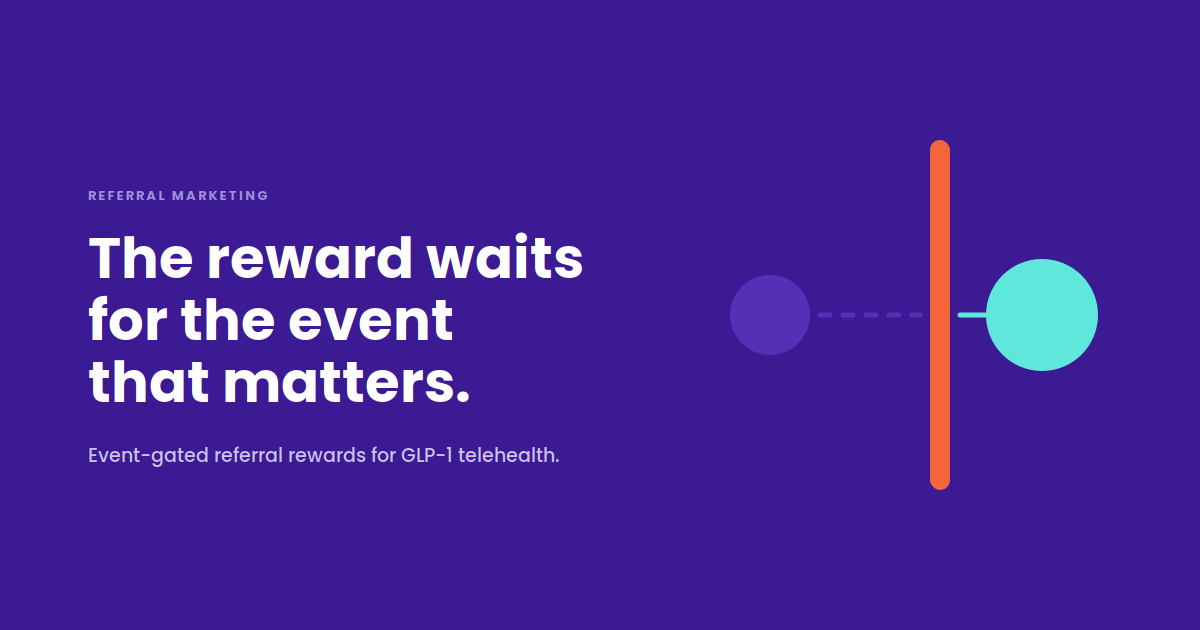
GLP-1 is one of the fastest-growing categories in telehealth, and most of the marketing conversation around it is about acquisition: paid search, influencer partnerships, affiliate and partner programs. All of those have a place in a GLP-1 growth stack.
But GLP-1 is a different kind of purchase than most telehealth categories. It's an ongoing prescription, often self-injected, with a real commitment curve. Customers considering a weight loss program or metabolic health treatment don't just want a good price. They want to hear from someone who has actually done it. Customer referral is the channel built to capture exactly that.
Building a telehealth referral program for a prescription product, though, is a workflow problem before it's a marketing problem. Most referral software assumes the qualifying event is a purchase. In prescription telehealth, the event that actually matters usually happens later: after intake, provider review, or prescription approval. That gap between checkout and the real qualifying event is the thread running through everything below.
At Friendbuy, we've worked with subscription and regulated businesses to design referral programs around event-based rewards rather than simple checkout events. The patterns below are drawn from that work.
Word of mouth outperforms paid channels for GLP-1 brands because starting treatment is a high-commitment decision, and a friend who has already gone through intake, talked to a provider, and stuck with treatment is a more credible source than any amount of paid content.
Referral works well across telehealth generally, but GLP-1 raises the trust bar. It's not a one-time purchase or a low-commitment subscription. Customers starting a weight loss program or an obesity treatment plan are self-administering an injectable medication, often for months, and deciding to start isn't a small decision.
Unlike many telehealth categories, a customer's GLP-1 journey may become visible to friends and family over time. That means these conversations frequently start offline, long before anyone visits a website. A referral program doesn't create those conversations. A referral program captures and measures conversations that are already happening, and gives the person already vouching for the brand a reason to send a link instead of just a compliment.
Yes. Brands run referral programs for prescription telehealth products by rewarding the customer relationship rather than the medication itself: rewards are issued as account credit, released only after a qualifying business event such as prescription approval, and structured so that no prescription or treatment details are exposed. Program design and state regulations matter, so every implementation should be reviewed with legal counsel.
This question comes up in nearly every conversation we have with brands in this space, and the brands that operate successfully in the category converge on the same three principles:
None of this requires avoiding referral marketing. It requires designing the reward mechanism around the constraints of a regulated product from the start, rather than retrofitting a generic ecommerce referral template after the fact.
(This section is informational, not legal advice.)
An event-gated referral program releases rewards only after the brand's system of record confirms a qualifying business event, such as an approved prescription or a completed consult, rather than firing the reward at checkout. Here is the workflow end to end:
Step 3 matters as much as it does because a prescription that gets rejected or a consult that doesn't convert shouldn't trigger a payout. Anchoring the reward to checkout instead of the real qualifying event creates false positives and may reward activity before the business has confirmed that the intended customer milestone actually occurred.
This is where standard referral tooling runs into trouble. Traditional ecommerce referral software is built around a simple assumption: a purchase is the finish line, and the reward fires the moment it happens. In prescription telehealth, that assumption doesn't hold. The system of record, not the referral platform, is what actually knows whether a prescription was approved or a consult was completed. So the system of record should decide when the qualifying event has occurred, then tell the referral platform whether a reward is authorized, rather than the referral platform inferring success from a checkout event it can see but can't fully interpret.
Friendbuy supports this model through event-based referral rewards: the brand's system sends a conversion event server-side when the qualifying milestone occurs, and the platform holds the reward until that event authorizes release. That is a fundamentally different architecture than firing a reward off a shopping cart event. For programs that require additional oversight, a manual approval step can also be inserted before the reward is released.
Affiliate and referral solve different problems: affiliate is a reach channel that pays commissions to third parties for bringing in new audiences, while a customer referral program activates existing customers who already trust the brand. Most GLP-1 telehealth brands can run both side by side, but the two need different mechanics.
The economics row deserves attention for subscription businesses specifically. Commission-based models typically charge a percentage of the revenue they help generate, which makes sense for a channel built on ongoing reach. For a subscription business with strong retention, though, that percentage can compound every renewal, not just at the first sale. It's worth understanding which problem you're paying to solve before choosing a fee structure.
Link-based referral tracking breaks in telehealth stacks because prescription telehealth businesses run more complex, more frequently changing infrastructure than a typical DTC brand: multiple billing systems, subscription platforms, and periodic replatforming as the business scales. Coupon codes and long tracking links often don't survive that environment's redirect chains.
In practice, the failure shows up as broken attribution after a platform migration, redirects that strip referral parameters along the way, and browser-specific behavior interrupting what should be a simple customer journey. None of that is unique to any one platform. It's a structural mismatch between link-based tracking and how telehealth businesses actually run their tech stacks.
The durable approach combines referral attribution with server-side conversion validation: the customer still enters through a referral link or code, but the brand's system sends the purchase, fulfillment, or prescription-approval event directly to the referral platform, and reward issuance is handled through a webhook rather than relying on browser-side tracking alone. Server-side validation is less visible to the customer but significantly more resilient operationally, because it doesn't depetnd on browser behavior or a redirect chain surviving the entire journey from click to fulfillment.
Good referral performance in prescription telehealth is measured by how many referrals make it through intake, provider review, and the qualifying event that matters to the business, not by how many referral links get shared. Programs built around downstream business milestones are evaluated differently than ecommerce referral programs optimized around checkout conversions, and that's the right thing to optimize for, even though top-of-funnel numbers alone won't tell the full story.
Within that framing, the general pattern of referral performance still holds: referred customers tend to convert at higher rates than standard traffic and often carry greater lifetime value. What changes in a regulated category is where the program lives or dies: in the gap between the click and the reward, not at the share stage.
Referral software for telehealth needs to give the brand control over five things:
These aren't features to check off. They're the questions that determine whether a patient referral program can actually run inside a regulated business without creating legal or operational risk. For a broader look at how these capabilities compare across vendors, see our guide to referral program software.
Referral marketing isn't a replacement for the acquisition channels GLP-1 brands already use. It's the channel that does something those can't: turn an existing customer's real experience into the reason a friend decides to start. Getting it right in this category means designing the reward and the trigger around the fact that you're marketing a prescription, not bolting a standard ecommerce referral template onto a regulated product. The architecture that makes that possible is event-gated rewards: qualifying events defined by the business, validated server-side, released only when the milestone is real.
Can GLP-1 telehealth brands legally offer referral rewards? Many brands operate referral programs in this category by rewarding the customer relationship rather than the medication: account credit instead of medication discounts, rewards gated on qualifying business events, and no treatment details exposed in confirmations. The right structure depends on the business, the product, and applicable state regulations, so implementations should be reviewed with legal counsel.
What is an event-gated referral program? An event-gated referral program releases rewards only after the brand's system of record confirms a qualifying business event, such as an approved prescription, a completed consult, or a fulfilled order, rather than releasing the reward at checkout. The system of record decides when the milestone has occurred and authorizes the referral platform to release the reward.
What event should trigger a referral reward for a prescription product? The trigger should be the business event that confirms a real customer was acquired: prescription approval, a completed consult, or a first fulfilled order. Checkout is the wrong trigger for prescription telehealth because a checkout can occur without a prescription ever being approved.
Does HIPAA apply to a telehealth referral program? Referral programs in prescription telehealth involve HIPAA-related considerations, including whether a Business Associate Agreement applies and how referral confirmations are worded. A well-designed program shares only the minimum information needed to confirm reward eligibility and never surfaces prescription or treatment details.
Can a referral program and an affiliate program run at the same time? Yes. Affiliate is a reach channel that pays third parties to bring in new audiences; customer referral activates existing customers who already trust the brand. GLP-1 brands commonly run both, with different economics and different tracking mechanics for each.
Why do telehealth brands use server-side referral tracking? Telehealth stacks tend to involve multiple billing systems, subscription platforms, and periodic replatforming, which break coupon codes and tracking links. Server-side conversion validation sends the qualifying event directly from the brand's system to the referral platform, so attribution and reward release don't depend on browser behavior or redirect chains.


.avif)