How a Premium Footwear Brand Turned Word-of-Mouth Into a 10x Growth Engine
OluKai is a premium, ocean-inspired Hawaiian lifestyle brand known for handcrafted footwear that blends authentic Pacific craftsmanship with modern performance. Built on a deep connection to Hawaiian culture and the ocean, OluKai has cultivated a fiercely loyal customer base across DTC, retail, wholesale, and Amazon channels, all without compromising the brand's premium identity through heavy discounting.
OluKai is a premium, ocean-inspired Hawaiian lifestyle brand known for handcrafted footwear that blends authentic Pacific craftsmanship with modern performance. Built on a deep connection to Hawaiian culture and the ocean, OluKai has cultivated a fiercely loyal customer base across DTC, retail, wholesale, and Amazon channels, all without compromising the brand's premium identity through heavy discounting.
Overview
Friendbuy Plan
Friendbuy Products
Referral Program Software
Integrations
Results
10x
Growth in referral program performance
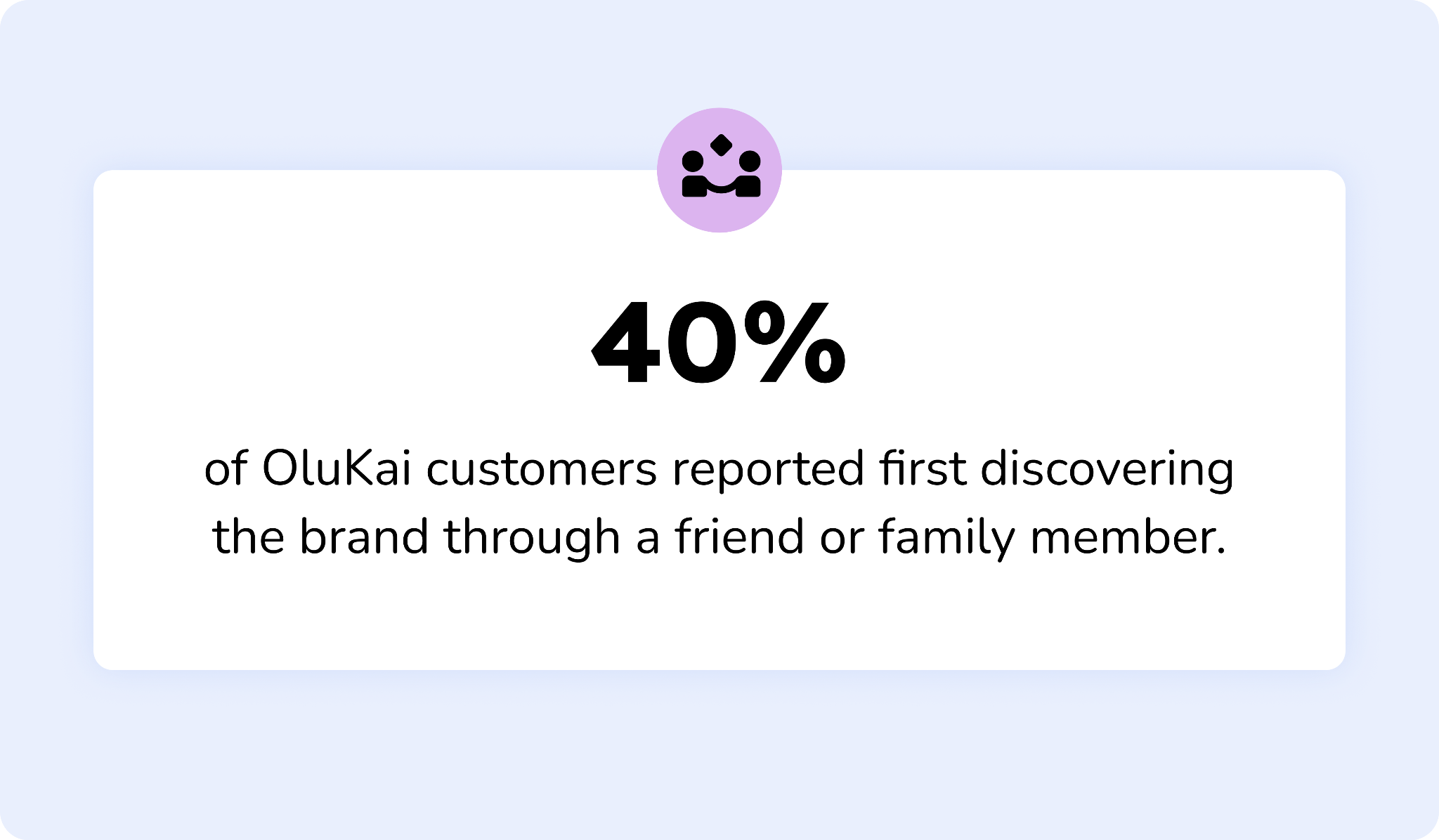
40%
Of customers who discovered OluKai through a friend or family member
25%
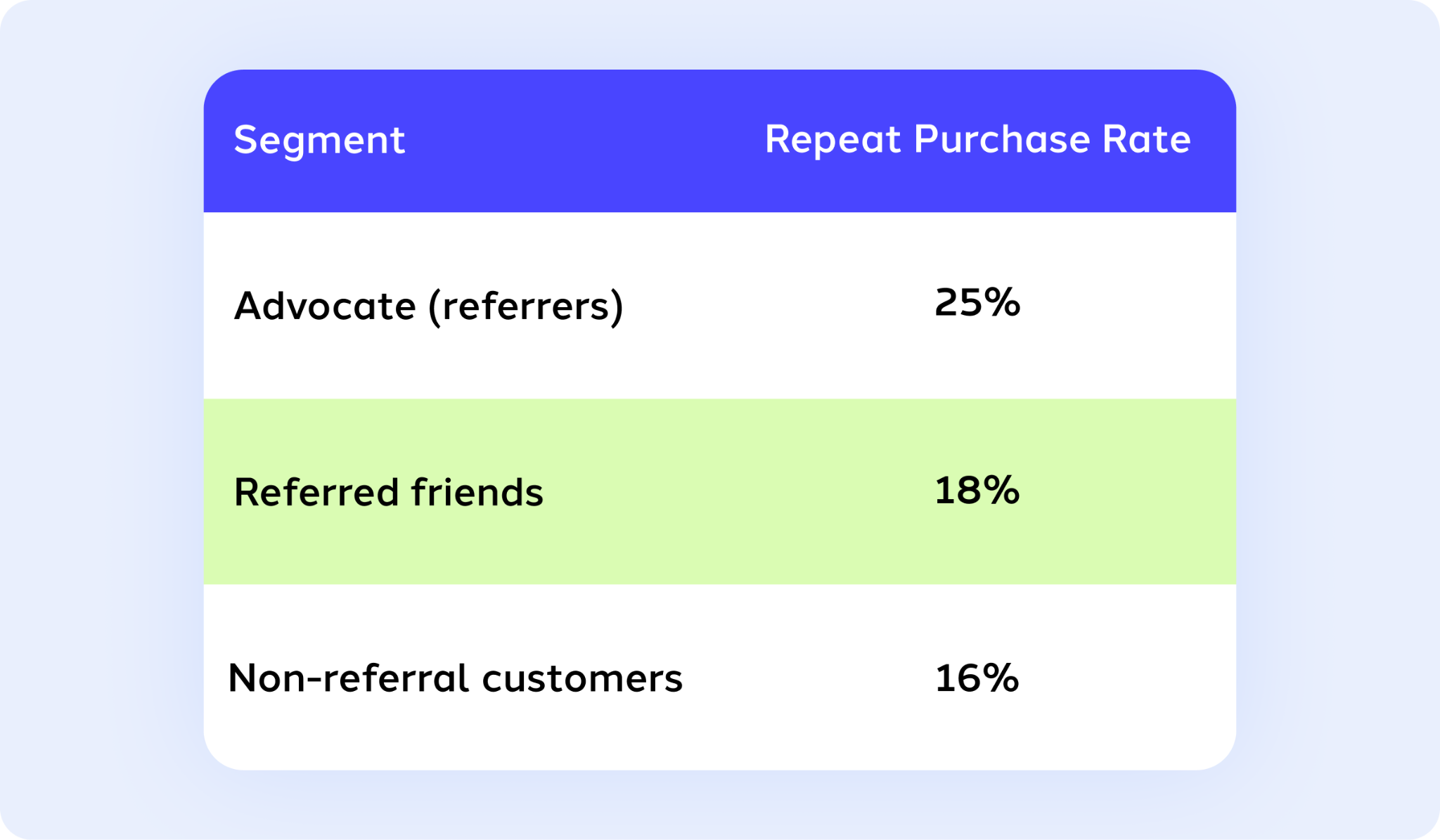
Repeat purchase rate among advocates vs. 16% for non-referral customers
OluKai was caught between two forces pulling in opposite directions.
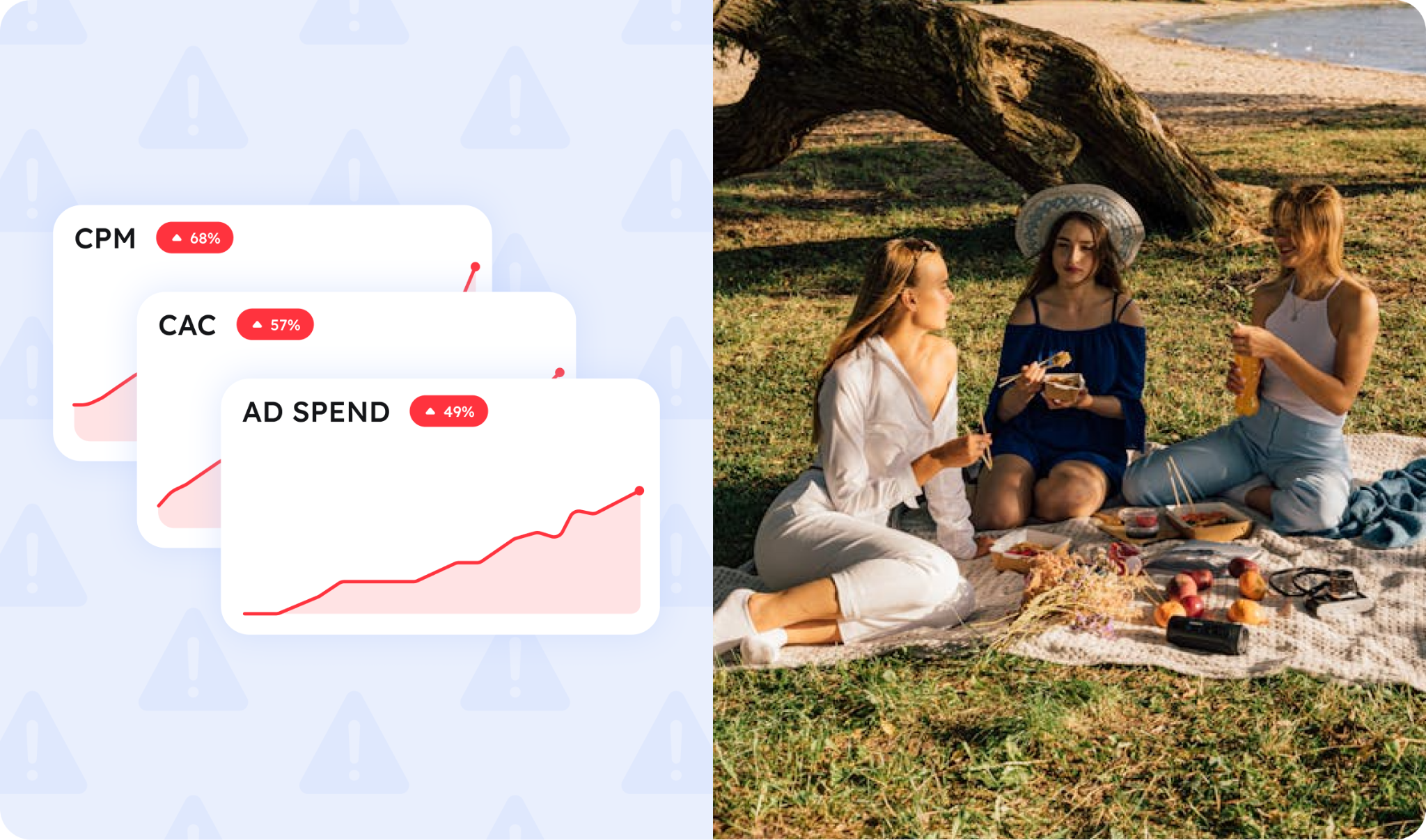
On one side: rising paid media costs. CPMs were climbing. CAC on paid channels was increasing with diminishing returns. The natural ceiling on paid search meant the brand couldn't simply spend its way to growth.
“We were spending more every quarter just to stay in place. CPMs kept climbing, our CAC was creeping up, and we couldn't just throw a sitewide sale at the problem, that's not who we are. We needed a channel that could grow with us without costing us the brand we'd spent years building." Ben Bolognini, Vice President of Ecommerce
On the other: a brand identity that depended on not discounting. For most DTC brands, the go-to lever for goosing acquisition is a promo code or a sitewide sale. OluKai doesn't play that game. As a premium brand with deep roots in Hawaiian craftsmanship and culture, offering arbitrary discounts would erode the very perception that makes customers willing to pay full price.
The result: a growth strategy that felt stuck, with no obvious path forward.
The deeper problem? The real acquisition engine was already running. It just wasn't captured.
The Insight
A post-purchase customer survey revealed something that reframed everything:
Word-of-mouth wasn't a nice-to-have. It was already the brand's single largest acquisition channel — larger than paid search, larger than organic, larger than any individual marketing program. It was also completely unstructured, untracked, and unactivated.
OluKai stopped asking "how do we find more customers?" and started asking "how do we scale what's already working?"
The Solution
OluKai partnered with Friendbuy to build a referral program that could systematically activate, track, and amplify the word-of-mouth already happening in the wild.
But they didn't build a generic referral widget. They built a program that felt like OluKai.
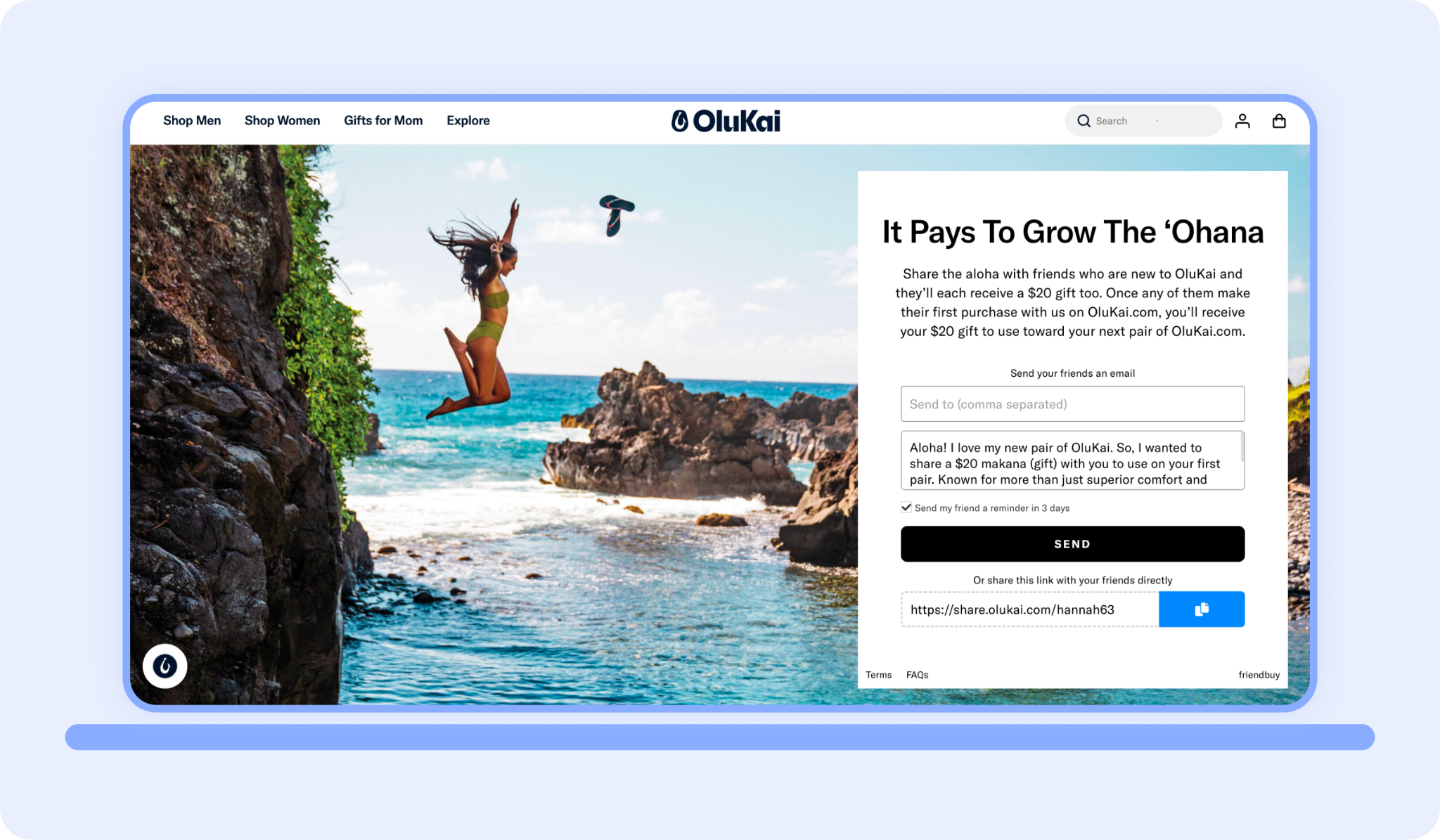
"We weren't going to put a generic referral widget on our site and call it a day. It had to feel like OluKai. The ʻOhana framing wasn't a creative decision - it was the only decision that made sense for who we are." Ben Bolognini, Vice President of Ecommerce
Brand-Led Positioning, Not Discount-Led
Most brands default to a transactional give/get mechanic. OluKai took a different approach.
They anchored the program in ʻOhana, the Hawaiian concept of family and community that sits at the core of their brand identity and their top-selling product line. Referral became an extension of brand storytelling, not a coupon mechanism. Advocates weren't pitching a discount to their friends; they were inviting them into a community.
This distinction mattered enormously for a brand whose equity lives in meaning, not markdown.
Premium UX Built for Conversion
Referral programs fail when they're confusing. OluKai invested in:
Clean, intuitive experience with minimal friction to share
Clear value proposition for both the advocate and the referred friend
Thoughtful placement across key touchpoints, not buried in a footer
As OluKai's team put it: "The easiest UX and clearest understanding of why I should participate is critical."
Strategic Placement Across the Full Customer Journey
OluKai didn't treat referral as a single pop-up. They embedded it across the customer journey at the moments that drive the most intent:
Post-purchase - the highest-intent moment, when satisfaction is highest and sharing feels natural
Pre-purchase - capturing social sharing early, before the transaction is complete
On-site touchpoints - reinforcing participation continuously, not just once
This turned referral from a feature into a system, one that worked whether customers were in a buying moment or just browsing.
Reframing Incentives as Acquisition Investment
OluKai shifted how they thought about referral rewards. Instead of treating them as a cost center or a discount, they reframed them as acquisition spend — with a key advantage: the customer being acquired was being referred by someone who already knows and trusts the brand.
They also observed that referred customers, like gift card recipients, often spend beyond the incentive value, increasing AOV even while reducing CAC.
Friendbuy's Role: Partner, Not Just Platform
Friendbuy provided full-service implementation, handling the technical build, UX design aligned to OluKai's brand standards, program strategy consultation, and ongoing optimization support. For a brand with exacting standards around creative and experience quality, having a partner who could execute at that level was essential.
"We always knew our customers loved the brand, we could feel it. What we didn't realize was how much of our growth was already coming from them telling their friends. Friendbuy gave us the infrastructure to actually see it, track it, and scale it. The referral program didn't create word-of-mouth at OluKai. It just finally gave it somewhere to go." Ben Bolognini, Vice President of Ecommerce
The Results
By activating and systematizing word-of-mouth, OluKai achieved results that paid acquisition simply couldn't match.
Acquisition Impact
10x growth in referral program performance, turning a passive channel into a material acquisition engine.
Referral now drives measurable new customer acquisition at a cost structure that competes favorably with paid media, without the rising CPM problem, without the constant content production overhead, and without the brand risk of heavy discounting.
Customer Quality
Referred customers aren't just cheaper to acquire, they're better customers.
They arrive with built-in trust, having been recommended by someone they know
They convert at higher rates than paid channels
They show stronger long-term retention and LTV, consistent with the higher-quality cohort behavior seen across Friendbuy's customer base
The repeat purchase data tells the full story:
"Referred customers come in pre-sold. They've already heard from someone they trust that OluKai is worth it. That changes the entire relationship from the first purchase." Ben Bolognini, Vice President of Ecommerce
Advocates, the customers actively sharing the program, retain at the highest rate of all, nearly 60% above the baseline. Even referred friends, coming in as brand-new customers, out-retain the average. This isn't a coincidence: referral selects for customers who are genuinely enthusiastic about the brand, not just responding to a promotion.
A Self-Sustaining Growth Engine
Unlike paid media, which stops delivering the moment you stop spending, the referral program compounds. Every new customer acquired through referral becomes a potential future advocate. The program runs largely on autopilot after setup, without requiring monthly budget infusions or constant creative refreshes.
Why It Worked
They didn't create demand, they captured it
Word-of-mouth was already OluKai's #1 acquisition channel. Friendbuy gave them the infrastructure to systematize and scale what customers were already doing organically.
They aligned referral with brand identity, not discounts
For a premium brand, emotional alignment matters more than incentive size. Building the program around ʻOhana made participation feel like an extension of brand values — not a transaction.
They activated trust at scale
Paid media buys reach. Referral buys trust, the kind that converts at higher rates, retains longer, and produces better customers. OluKai effectively enabled their best customers to go find more of their best customers.
They turned owned data into a compounding growth engine
OluKai is now positioned to layer in zero-party data and advocacy behavior signals to further amplify their highest-value customer cohorts. The result is a flywheel: best customers bring in more best customers, who become advocates, who bring in more.
Key Takeaways
Your best acquisition channel might already exist
Check your post-purchase survey data. If "friend or family member" is a top response, you're sitting on an underactivated growth engine, and you don't need to build demand from scratch.
Referral is a system, not a feature
Winning programs are embedded across the entire customer journey, not dropped in as a widget or a one-time pop-up. Strategic placement at post-purchase, pre-purchase, and on-site touchpoints makes the difference.
Calculate your true CAC
Include hidden costs: content production, creator fees, team time, testing, and optimization. The real cost of paid media is often 2–3x the media spend alone. Referral's cost structure looks very different in that comparison.
Referral solves multiple problems simultaneously
Beyond acquisition, a well-built referral program improves customer quality, LTV, retention, and brand loyalty, all while reducing dependence on rising paid media costs.
Word-of-mouth is happening whether you track it or not
The question isn't whether your customers are recommending you. The question is whether you're capturing credit, rewarding advocates, and turning one referral into ten.
For premium brands: brand alignment beats incentive size
Customers respond to meaning and community more than they respond to discount value. Anchor your program in what the brand actually stands for.
The Bottom Line
OluKai didn't win by spending more. They won by trusting what their customers were already doing, and giving it a structure.
By partnering with Friendbuy to build a brand-native referral program, OluKai scaled word-of-mouth from an invisible, untracked channel into a 10x growth engine, one that acquires better customers, at lower cost, without touching the brand equity they've spent years building.
The result is a marketing engine that compounds over time rather than depleting the budget with each campaign.
"Referral isn't a campaign for us anymore. It's infrastructure. It runs, it compounds, and every new customer it brings in has a real shot at becoming the next person who brings someone else in. That's the kind of growth that actually means something." Ben Bolognini, Vice President of Ecommerce
Ready to activate your own customer advocates?
See how Friendbuy can help you build a referral program that turns your best customers into your best growth channel.














.avif)

