Table of contents
Join our Community!
Oops! Something went wrong while submitting the form.
Stay up to date with the latest insights, trends, and tips for growing your business through referral and loyalty programs. Let's stay connected!

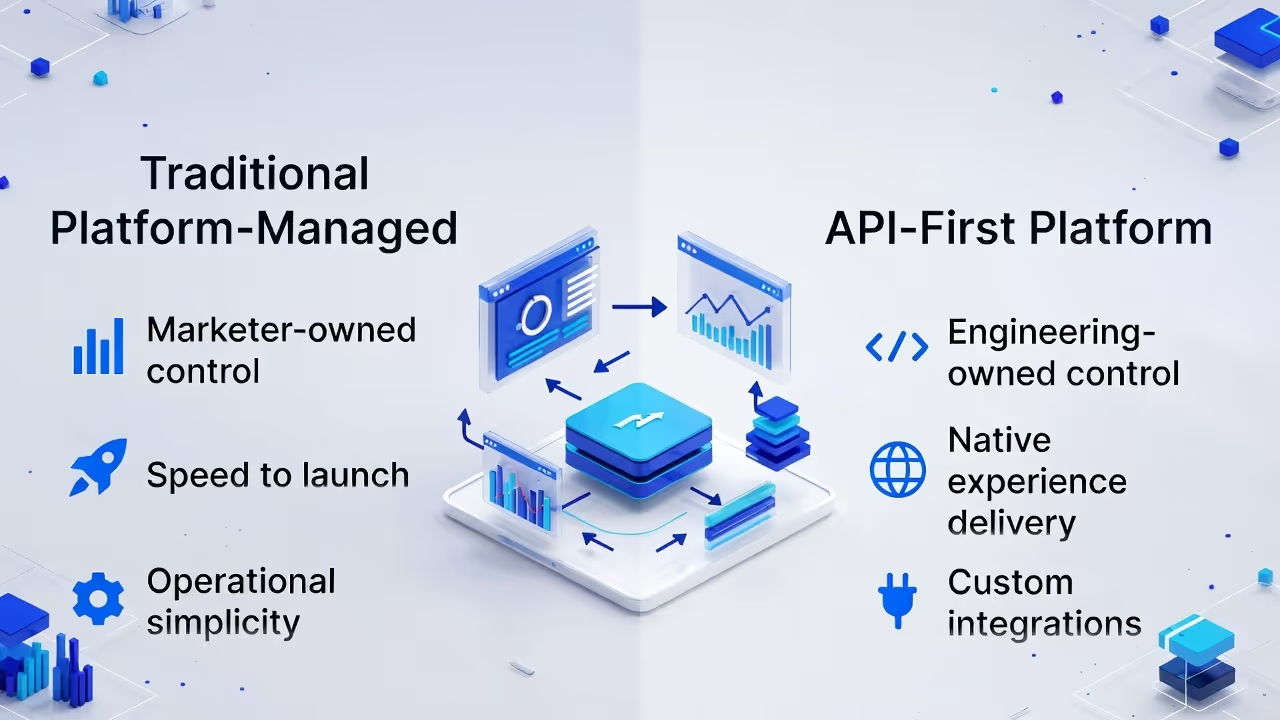
API-first loyalty platforms expose reward logic, customer data, and incentive rules through structured APIs rather than confining them to dashboard workflows. For some organizations, this architecture unlocks flexibility, integration clarity, and long-term scalability. For others, it introduces unnecessary complexity.
The key is understanding when API-first loyalty aligns with your operating model — and when it does not.
API-first loyalty platforms are typically evaluated by organizations facing structural complexity rather than basic feature gaps. These organizations focus on how loyalty logic integrates into their broader system architecture.
Three organizational profiles commonly consider API-first loyalty.
These organizations operate across brands, geographies, or business units. Incentive logic — including loyalty and referral rewards — must remain portable, auditable, and centrally governed across properties.
They are often consolidating rule governance under a unified framework to prevent duplication, local overrides, and fragmented accounting. Tenant isolation, change control, and ledger transparency matter as much as flexibility.
In this environment, loyalty cannot function as an isolated application. It must integrate cleanly into the organization’s broader commerce, data, and governance architecture.
These teams prioritize control of how the front-end customer experience is delivered. They operate custom checkout flows, native mobile applications, or proprietary front-end surfaces where engineering owns the experience layer.
They want earning logic, referral validation, tier progression, and reward issuance to be programmable and embedded within their event pipelines. Vendor-managed UI components and dashboard-based configuration may still be useful, but they cannot be the only mechanisms through which loyalty logic is governed.
For these organizations, API-first loyalty represents architectural alignment and front-end autonomy.
High-growth commerce brands increasingly integrate loyalty with subscriptions, lifecycle automation, CDPs, SMS platforms, and warehouse analytics.
They may not require a fully headless deployment. However, they do require loyalty events — purchases, refunds, renewals, pauses, referral validations, tier changes, and custom behavioral triggers — to participate reliably in their broader stack. Marketing teams need iteration flexibility, while engineering teams require structural integrity.
In these cases, API-first capability often provides long-term flexibility, even when deployed in hybrid form.
API-first loyalty platforms can unlock significant flexibility, portability, and integration clarity in these contexts. It also introduces additional considerations around governance, ownership boundaries, and integration discipline.
Its value depends on operating model:
With those conditions in mind, it becomes easier to define what API-first loyalty actually entails — and how it differs from platforms that merely “offer APIs.”
Rarely become constrained at launch. Constraints emerge as the business evolves.
As transaction volume increases and brands expand their footprint, incentive logic becomes more nuanced. Structural pressures emerge due to growing organizational complexity.
Early-stage loyalty programs are often straightforward: points per dollar, fixed tiers, and simple referral incentives.
Over time, incentive strategies may expand to include:
As incentive logic becomes more sophisticated, configurations designed for standard use cases can feel constrained. Exceptions accumulate, logic becomes layered, and governance demands increase.
Loyalty interacts continuously with commerce and subscription platforms, marketing automation tools, identity layers, and analytics pipelines.
As integrations multiply, synchronization becomes critical. Consider the impact of:
When loyalty state drifts from commerce state, downstream effects follow:
At scale, synchronization is a structural requirement.
As organizations expand across brands or regions, governance complexity rises.
Teams may require:
Without clear architectural separation, duplication of logic can occur. Regional overrides can introduce inconsistencies. Accounting may fragment across properties. Change management becomes reactive rather than controlled.
These pressures signal that the organization has outgrown its initial incentive model. At this point, teams reassess whether their loyalty architecture can continue to evolve without structural strain.
An API-first loyalty system exposes loyalty capabilities as structured, programmatically accessible services rather than confining core logic to dashboard workflows.
In practical terms, this means that loyalty operates through clearly defined components:
Each event is processed against defined policies. Each resulting change is recorded in a ledger that functions as the system of record.
Crucially, logic and presentation are separated. The rules that determine how points are issued or tiers are calculated do not depend on where or how those experiences are rendered. Customer-facing UI components — widgets, dashboards, mobile views — may be provided by the vendor, built in-house, or combined in hybrid form. The underlying rule engine remains consistent.
API-first capability does not require API-only deployment. Many mature implementations combine structured APIs with vendor-managed dashboards and UI surfaces where speed and simplicity are beneficial. The defining characteristic is that core loyalty logic is programmatically accessible and not limited to manual configuration alone.
This architectural separation enables loyalty to participate as a component within a broader system rather than as a standalone application.
Not all platforms that provide APIs are architected in an API-first manner.
An API-first loyalty platform provides parity between its programmatic interface and its dashboard interface. Core flows — earning, redemption, tier qualification, referral validation, reversals, and manual adjustments — can be initiated, modified, and audited through APIs. Rule logic can be created or updated without relying exclusively on vendor-managed workflows.
By contrast, API-available platforms often expose limited endpoints for reading data or triggering predefined actions. More complex changes may still require dashboard configuration, support intervention, or rigid template structures. This distinction may not matter in early deployments, but it becomes consequential when organizations attempt to evolve rule logic, integrate with additional systems, or maintain centralized governance across properties.
Evaluation should therefore focus not simply on whether APIs exist, but on whether they cover real customer journeys end-to-end. For example:
API-first maturity is defined less by the presence of endpoints and more by the completeness and reliability of those endpoints in practice.
When loyalty logic is fully accessible through structured APIs — while still allowing for hybrid deployment where appropriate — it becomes easier to align loyalty with the broader commerce and data architecture already in place.
When structural pressures increase — more nuanced incentive logic, deeper integrations, multi-brand governance — architecture matters more than feature lists.
API-first loyalty does not eliminate complexity. It provides a structural model for managing it.
As incentive strategies mature, rule logic must adapt.
Organizations may need to:
In configuration-bound systems, these changes can require layered workarounds or heavy reliance on vendor-managed workflows. In an API-first architecture, rule logic is separated from presentation and programmatically accessible. Changes can be made through structured policies rather than through reconfiguration.
This reduces the likelihood that evolving incentive logic forces a broader replatforming decision.
For multi-brand organizations, a shared rule framework can be applied across properties while preserving brand-specific differentiation.
Modern commerce systems already operate through events. Purchases, refunds, subscription changes, and behavioral triggers flow through commerce platforms, CDPs, ESPs, and analytics pipelines.
In an API-first loyalty model, loyalty participates in this event architecture rather than operating as a parallel system.
Structured events — purchase completions, reversals, renewals, referral validations, tier transitions — can be emitted reliably into downstream systems, enabling real-time segmentation and lifecycle orchestration.
For both subscription-first brands and transaction heavy retailers, accurate handling of renewals, cancellations, refunds, and partial returns is essential. Event-native integration improves synchronization and reduces dual-source-of-truth risk.
As loyalty programs scale, analytics expectations increase.
Teams seek to measure:
API-first loyalty systems expose raw event data and maintain auditable ledgers, allowing loyalty data to integrate directly into warehouse and BI environments.
Structured customer profiles further enhance this model. When loyalty and referral events enrich a normalized customer profile — rather than remaining siloed in dashboards — segmentation and behavioral modeling become more precise. Cohort analysis can incorporate loyalty state without manual exports or reconciliation.
As organizations consolidate data into CDPs and warehouse-native analytics systems, architectures that expose structured event-level data reduce downstream friction and improve decision confidence.
Organizations operating across brands or regions must balance consistency with flexibility.
API-first architectures support a shared loyalty core — identity, wallets, ledger accounting — while allowing brand-specific rule layers and reward catalogs where differentiation is required. Tenant isolation and governance boundaries reduce duplication and preserve accounting discipline.
As organizational complexity increases, maintaining centralized rule logic without duplicating systems becomes structurally advantageous.
API-first loyalty is well suited to organizations that:
It may introduce unnecessary overhead for organizations that rely primarily on standardized front-end surfaces, have limited engineering bandwidth, or do not anticipate frequent rule evolution.
Importantly, API-first capability does not require API-only deployment. Many mature organizations adopt hybrid models — combining structured APIs with dashboard configuration and UI components to balance flexibility with operational efficiency.
The architectural objective is alignment with operating model and long-term system design.
Not all API-first claims reflect the same architectural depth.
Organizations evaluating API-first loyalty platforms must distinguish between surface-level API access and true API maturity. What matters is whether those APIs support real operating conditions at scale — reliably, consistently, and without hidden constraints.
API maturity begins with parity.
Core flows — earning, redemption, tier qualification, referral validation, reversals, manual adjustments — should be programmatically accessible. When certain capabilities can only be modified through a dashboard — even if APIs exist for reading data — flexibility is functionally constrained.
This distinction may not block launch, but it becomes consequential as incentive logic evolves or governance requires centralized rule management across properties.
Evaluation should therefore focus on complete journey coverage rather than isolated endpoints. For example:
Incomplete parity can introduce operational friction as complexity increases.
Event-driven architectures depend on reliable event handling — especially under load.
Webhook behavior determines whether loyalty state remains synchronized with commerce state during peak traffic, subscription cycles, or high-volume campaigns.
Mature systems support:
Without these safeguards, discrepancies accumulate. Duplicate rewards, delayed reversals, or inconsistent balances undermine customer trust and accounting integrity.
API maturity is also reflected in documentation and versioning discipline.
Enterprise-ready systems provide:
In enterprise environments, documentation quality often signals whether a platform was designed for durable integration or short-term configuration convenience.
When loyalty logic, identity data, and ledger accounting sit at the center of growth strategy, governance maturity becomes as important as feature breadth.
Referral programs often begin as simple incentives layered on top of loyalty mechanics. At scale, however, referral becomes a distinct acquisition channel with its own performance dynamics, attribution models, and risk controls.
In an API-first loyalty architecture, referral events — shares completed, conversions validated, rewards issued — can be modeled as structured events within the same system that governs loyalty logic. This allows referral activity to enrich the broader customer profile rather than existing as a separate reporting surface.
When referral operates within a structured event model, organizations can evaluate:
This depth of data becomes especially valuable when referral performance is analyzed alongside retention behavior, tier progression, and margin contribution.
Fraud integrity also depends on event discipline. Robust referral programs at scale require structured validation logic, eligibility enforcement, and clear accounting within the ledger. In API-first deployments, these controls are embedded in the same event-processing framework that governs earning and reversals, reducing reliance on manual review or fragmented tooling.
Over time, when referral and loyalty events contribute to a shared, structured customer profile, organizations preserve the ability to design compounding growth systems — where acquisition and retention incentives reinforce one another within a consistent data model. (For a deeper discussion of this framework, see our guide to how referral and loyalty compound growth systems.)
API-first capability provides the architectural foundation for treating referral as a measurable, governable channel rather than a bolt-on campaign mechanic.
Loyalty is often discussed as a program. At scale, it functions more accurately as a capability layer.
In API-first deployments — particularly those aligned with event-driven commerce stacks — loyalty logic operates as part of the broader system that governs growth rather than as a standalone application.
This does not mean API-first loyalty is appropriate for every organization. For teams with stable incentive models or limited integration requirements, hybrid deployments or configuration-driven approaches may be more aligned with their operating model.
But as incentive complexity, integration depth, and organizational scope increase, architectural alignment becomes critical.
When loyalty is treated as infrastructure:
The architectural objective is alignment with the organization’s operating model and long-term system design.
For teams evaluating loyalty platforms, the critical questions are structural:
API-first loyalty is one architectural model designed to address these questions. In many cases, the most durable implementations combine structured APIs with thoughtfully deployed UI and configuration layers — balancing flexibility with operational efficiency.
For a neutral comparison of architectural approaches, see our guide to API-first vs. traditional loyalty platforms.
For a broader evaluation framework, explore our enterprise loyalty software guide.
An API-first loyalty platform exposes core loyalty capabilities — including earning rules, tier qualification, referral validation, reversals, and ledger accounting — through structured, programmatically accessible APIs. The defining characteristic is full parity between API and dashboard capabilities, ensuring that core loyalty logic can be created, modified, and audited through code when required.
API-enabled loyalty platforms may offer APIs for reading data or triggering predefined actions, but certain capabilities remain confined to fixed dashboard configurations. API-first loyalty platforms provide programmatic control over core flows. If earning rules, tier logic, referral validation, or reversals cannot be created or modified via API, the system is API-enabled but not fully API-first.
API-first loyalty is most appropriate when an organization:
Organizations with stable incentive models and limited integration needs may find hybrid or configuration-driven approaches more aligned with their operating model.
Teams should evaluate:
The presence of endpoints alone does not indicate API maturity. Completeness, reliability, and governance discipline matter more than surface-level API access.
Yes. API-first loyalty architectures emit structured events — such as purchases, refunds, renewals, referral validations, and tier transitions — into CDPs, ESPs, SMS platforms, and subscription systems. Effective integration depends on event reliability, identity normalization, and full API parity across loyalty state, not on periodic data synchronization alone.
In mature API-first systems, referral events are processed through structured validation logic before rewards are issued. Eligibility enforcement, duplicate detection, and ledger-level accounting occur within the same event-processing framework that governs standard loyalty transactions. Robust fraud controls depend on structured event modeling and auditable ledger integrity rather than manual review or fragmented tooling.
API-first loyalty platforms expose raw event data and ledger transparency, enabling organizations to measure:
By integrating loyalty data directly into warehouse and BI environments, teams can perform cohort analysis and incrementality testing without relying solely on summarized dashboards.
No. API-first capability does not require API-only deployment. Many organizations adopt hybrid models that combine structured APIs with vendor-managed dashboards and UI components. The defining characteristic of API-first is programmatic access to core loyalty logic — not the absence of interface layers.


.avif)

