
.avif)

Executive Summary

This guide is written for enterprise and upper-mid-market teams evaluating loyalty software as a core growth system. It focuses on:
- The features that give teams real control and iteration velocity
- The technical foundations required to support modern workflows and integrations
- The financial requirements platforms must support to enable forecasting, accountability, and long-term program health
For enterprise brands, loyalty software should be evaluated as infrastructure that compounds value - or constrains it if chosen poorly.
Why Loyalty Software Decisions Break Down After Launch
Loyalty programs rarely fail because organizations misunderstand loyalty mechanics. They fail because the software underneath cannot keep pace as business needs evolve.
Early indicators often look positive: enrollment grows, rewards are issued, engagement ticks up. Friction appears later — when the business needs to leverage loyalty to support different objectives, when incentive structures must be recalibrated to reflect changing economics, or when operational complexity increases beyond what the platform was designed to handle.
In practice, enterprise brands use loyalty to support a range of initiatives throughout the year: accelerating repeat purchase during peak seasons, supporting new product launches, reinforcing retention among high-value segments, or protecting margin in tighter periods. Platforms built for static programs struggle when loyalty becomes a flexible business lever.
At that point, hidden constraints begin to surface:
- Routine changes require engineering tickets or vendor intervention
- Integrations only support partial or one-way data flow
- Reporting explains activity, but not business impact
These limitations are rarely obvious during initial rollout. They emerge as the organization tries to operate loyalty as an ongoing system rather than a one-time launch.
Enterprise evaluation therefore requires a different lens. The real questions are:
- Can the platform support evolving requirements without forcing structural workarounds?
- How much friction is introduced each time the program needs to shift direction?
- Can performance be measured and optimized as complexity increases?
Enterprise-ready loyalty software is defined less by surface features and more by how well it supports change, scale, and second-order effects.
Key takeaway
Most loyalty platforms don’t fail at launch — they fail when the business expects them to support new initiatives, tighter economics, or greater operational complexity without friction.
How Experienced Teams Evaluate Loyalty Program Software
Teams that have operated loyalty programs converge on a common insight:
features alone are insufficient without operational control, deep integrations across the growth stack, and durability.
Rather than evaluating loyalty as a fixed program, experienced teams assess whether the platform can support marketing-led execution at scale.
Marketing Control and Iteration Velocity
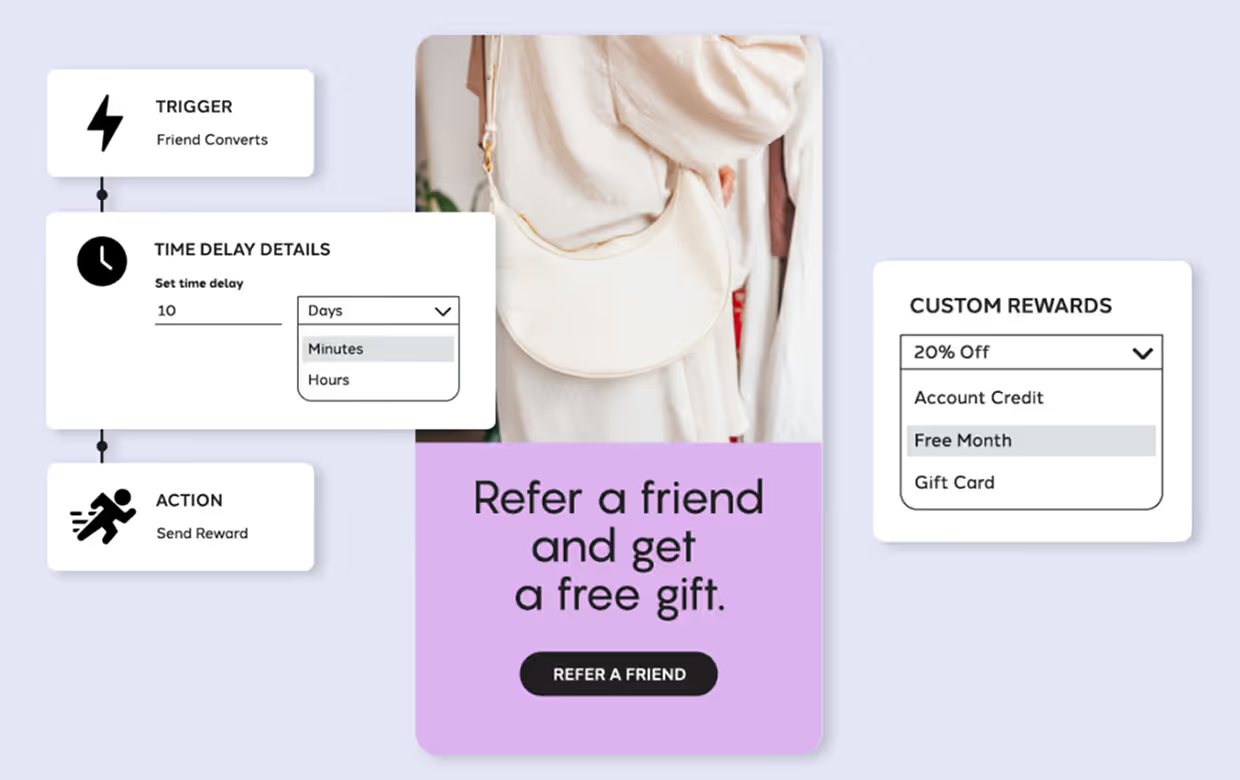
Marketing teams must be able to adjust earning logic, rewards, and qualification rules without engineering dependencies. Platforms optimized for initial rollout but not ongoing iteration quietly tax growth and limit responsiveness.
Integration and Activation Across the Growth Stack
Loyalty must integrate cleanly into email, SMS, CDPs, analytics, and other systems that power campaigns and customer journeys. Platforms that treat loyalty as a silo struggle to support real-world execution.
Architectural Flexibility (API-First vs. Rigid Platforms)
Beyond integrations, enterprise teams should also evaluate how loyalty software is architected. Rigid platforms embed business logic directly within predefined workflows, making extension and customization difficult as requirements grow. By contrast, API-first loyalty platforms expose core loyalty capabilities as composable building blocks, giving teams greater control over how loyalty is embedded into their broader systems.
This architectural flexibility matters most for organizations that expect loyalty to be tightly woven into custom experiences, data pipelines, or evolving technology stacks over time.
Financial Governance and Reporting
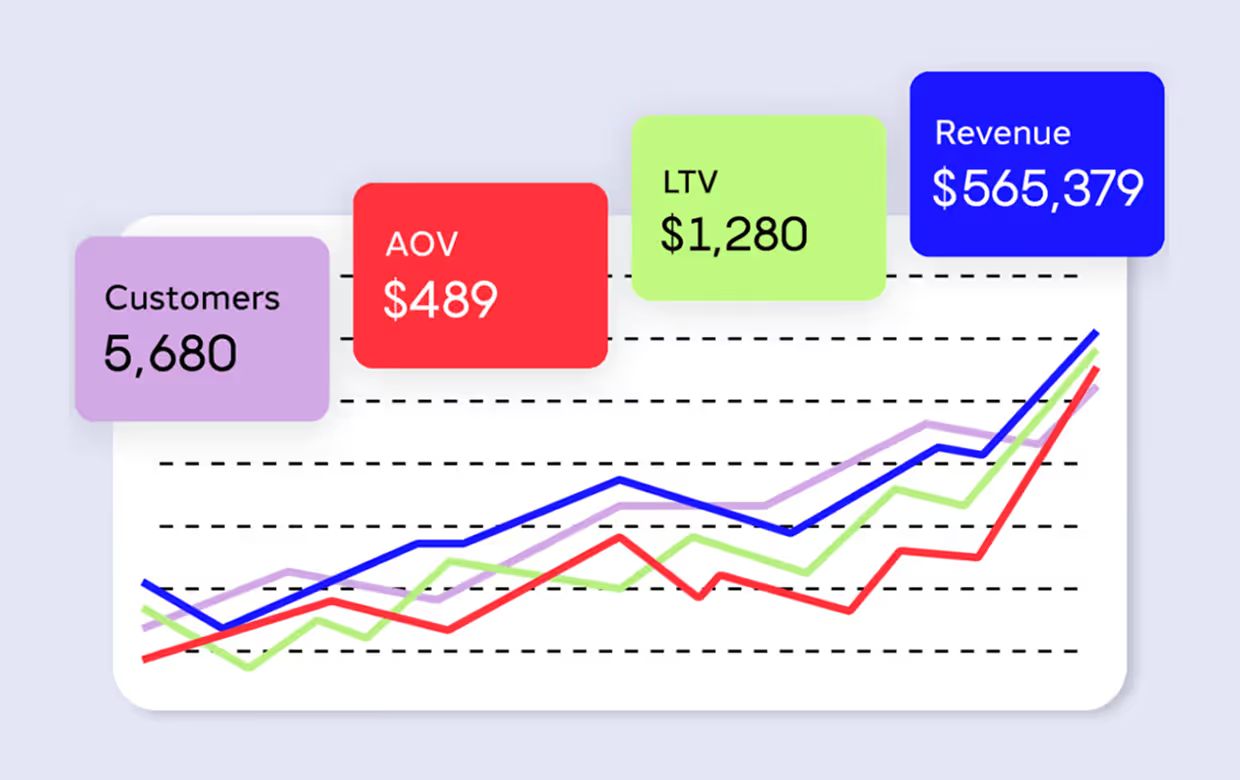
Finance visibility and reporting are essential for enterprise loyalty programs. The platform must provide clear, reliable insight into liability, redemption velocity, and projected cost so finance can forecast accurately and maintain confidence.
When those requirements are embedded in the system itself, teams can operate, iterate, and optimize loyalty programs without constant reconciliation or manual oversight.
This is why experienced teams evaluate loyalty software as marketing infrastructure, not a campaign add-on.
Key takeaway
Enterprise teams evaluate loyalty software as infrastructure — prioritizing operational control, integration depth, and long-term durability over surface-level feature lists.
The Core Loyalty Software Features That Matter at Enterprise Scale
The capabilities below are baseline requirements for enterprise teams that expect loyalty to operate as a flexible, performance-driven growth system.
For a view into how Friendbuy supports these requirements, see our platform capabilities.

Where Enterprise Platforms Separate from SMB Tools
SMB loyalty tools are designed for static programs and limited integration needs. Enterprise programs, by contrast, must operate reliably across a broader range of use cases.
Common enterprise failure points include:
- Templates that cannot accommodate new initiatives or channels
- Integrations that fail when workflows become more complex
- Reporting that explains activity but not impact
These limitations are inherent to the platform’s design, not the result of how the program was set up.
Enterprise platforms are built to support change without rework, enabling teams to extend loyalty into new initiatives without rebuilding core logic.
How Buying Committees Pressure-Test Loyalty Software
While marketing teams often drive loyalty initiatives, final decisions are scrutinized across the organization.
- Marketing validates control, iteration speed, and performance insight
- Product and Engineering assess integration depth and architectural fit
- Finance ensures liability, forecasting, and reporting discipline
- Procurement and Sales stakeholders look for defensible, repeatable justification
Platforms that cannot satisfy these perspectives introduce long-term risk.
Red Flags That Surface Too Late
Certain limitations rarely appear in demos but emerge once programs are live:
- Loyalty driven primarily by discounts rather than controlled value
- Manual workflows for routine changes
- Analytics that can’t support optimization
- Integrations that don’t scale beyond basic use cases
These are structural constraints, not temporary gaps.
Using Feature Evaluation to Run Better Demos
Enterprise teams should evaluate vendors based on how well platforms support real operating conditions at scale, not idealized scenarios.
Vendors should be asked to demonstrate:
- Rule changes aligned to different initiatives
- End-to-end earn, redeem, return, and tier flows
- Live performance and analytics visibility
- Financial reporting aligned with governance needs
Evaluations are strongest when they focus on how a platform operates today and how easily it can adapt as requirements change.
Choosing the Right Loyalty Program Software for Your Business
The right loyalty platform is defined by how well it supports shifting business objectives while operating within real operational and economic constraints.
Key takeaway
The right loyalty platform isn’t defined by features alone, but by how deliberately it supports your organization’s long-term operating model.
Enterprise brands that treat loyalty as flexible marketing infrastructure - deeply integrated, measurable, and responsive — are best positioned to generate compounding value.
Frequently asked questions
Everything you need to know about implementing cashback rewards for your loyalty program.
Enterprise loyalty software should provide control, integration, and measurement—not just surface-level mechanics. That includes flexible earning and reward logic, automated tier management, real-time performance visibility, and deep integrations across the growth stack.
Platforms are disqualified when limitations are inherent to their design, not fixable through configuration or process. Rigid templates, shallow integrations, manual workflows, and analytics that lack business impact typically surface after launch.
ROI should be measured through incremental impact, not enrollment alone. Enterprises should assess how loyalty affects purchase frequency, retention, and revenue contribution—and ensure analytics support ongoing optimization.
Marketing should own day-to-day loyalty execution, including earning logic, rewards, and campaign-level configuration. Product and engineering enable integration, while finance provides governance and reporting.
Enterprise-ready loyalty software is defined by durability under change. It must support evolving initiatives, integrate cleanly into a modern stack, provide reliable reporting, and scale operationally without rebuilding core logic.
Loyalty software should function as infrastructure, not a silo. It must ingest real-time signals, activate workflows across channels, and feed data back into analytics and BI tools so loyalty becomes a lever for coordinated growth.
.avif)

