Table of contents
Join our Community!
Oops! Something went wrong while submitting the form.
Stay up to date with the latest insights, trends, and tips for growing your business through referral and loyalty programs. Let's stay connected!

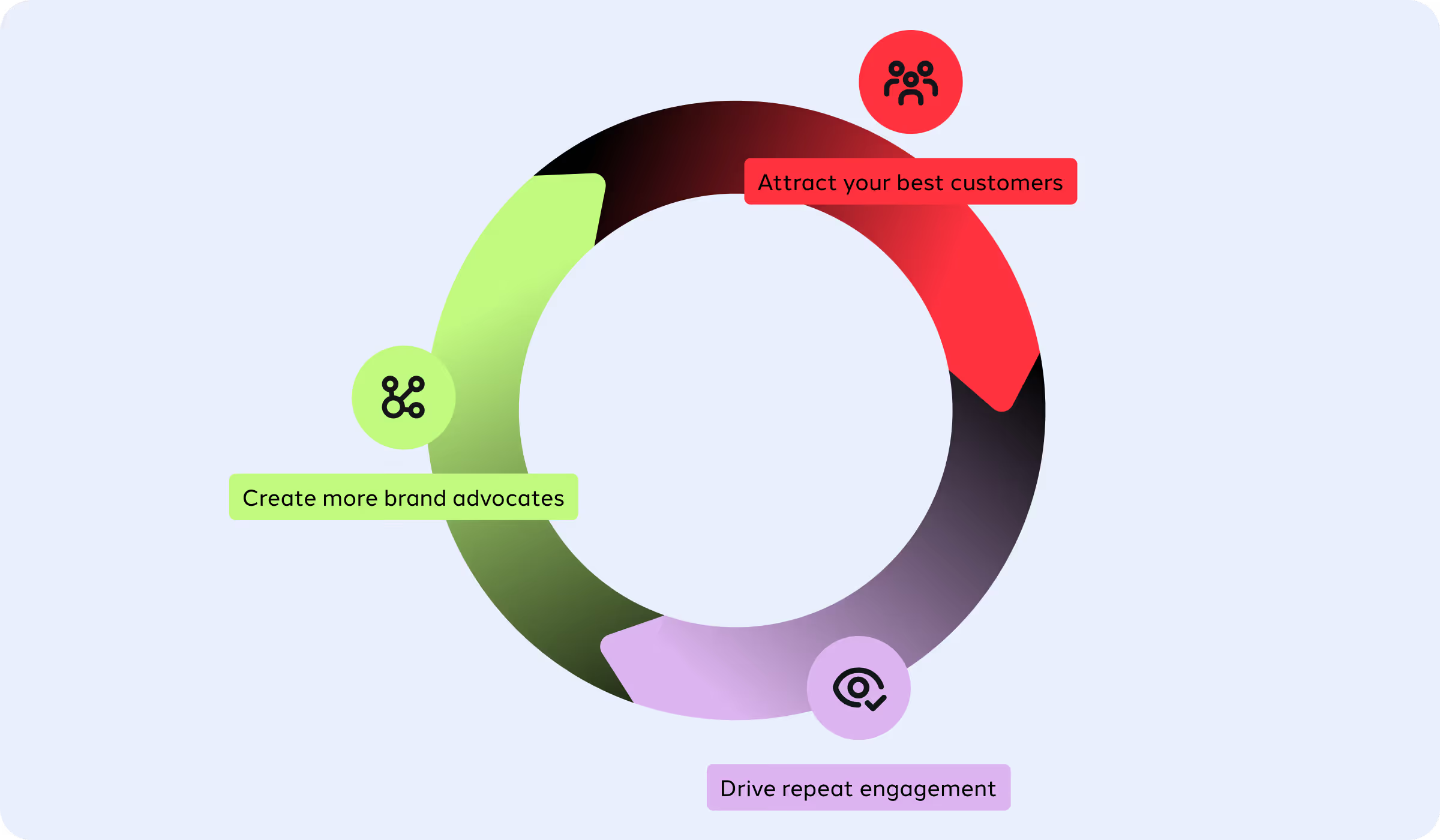
Most growth strategies treat acquisition and retention as separate engines.
The result is incremental improvement. What gets missed is the interaction between these systems.
Referral and loyalty are often discussed as adjacent levers. But when designed together, they form a compounding growth system — one that improves cohort quality, lowers acquisition cost, strengthens switching costs, and increases lifetime value simultaneously.
For a detailed breakdown of how subscription loyalty programs reduce churn across lifecycle stages, see our core framework on subscription loyalty programs.
In many organizations, acquisition and retention are managed as separate engines.
The underlying assumption is that who enters the system and how long they stay are independent variables.
In practice, this separation shows up clearly:
In each case, acquisition composition shapes retention dynamics.
Conversely, retention depth drives advocacy behavior. Customers who remain engaged long enough to accumulate habit, recognition, or meaningful value are more likely to recommend. Advocacy emerges from sustained participation — not just transactional satisfaction.
When acquisition and retention are measured independently, each appears incremental. When understood together, their interaction compounds.
The separation doesn’t just slow growth - it prevents the flywheel from forming.
Referral is often framed as a low-cost acquisition tactic. Its deeper value lies in cohort quality. Most operators intuitively understand that customers acquired through word of mouth tend to be higher quality. A referral program operationalizes that intuition - turning social proof into a predictable input for cohort composition.
Referred customers frequently arrive with different starting conditions:
These characteristics do not just improve conversion - they reshape downstream retention dynamics.
While paid acquisition often produces discount-driven customers, referred customers tend to enter with clearer expectations and social validation already in place.
Higher-intent customers:
By shifting the retention curve upward, cohort quality becomes a fundamental economic input to the business. A modest increase in cohort retention compounds into lower blended CAC, improved payback periods, and structurally higher lifetime value over time.
Loyalty systems reinforce the behaviors that increase psychological and economic commitment. They reward:
Over time, customers who progress within a system are no longer simply repeat buyers. They have invested time, attention, and status. That investment does two things:
For a detailed breakdown of how these loyalty mechanics reduce churn in subscription brands, see How Subscription Loyalty Programs Reduce Churn (With Examples).
Across industries, customers who remain engaged longer tend to exhibit higher referral propensity - not because they are prompted to share, but because their relationship has become part of their identity.
As loyalty strengthens retention, it expands the pool of customers capable of advocacy. As engagement deepens, referral likelihood rises. Over time, that interaction compounds: deeper retention increases promotable customers, and promotable customers introduce higher-intent cohorts.
The flywheel turns when retention depth and advocacy reinforce each other rather than being managed in isolation.
The compounding dynamic becomes most visible in the unit economics.
Consider a mid-sized subscription brand:
Now assume loyalty initiatives reduce churn modestly - from 30% to 27%. A three-point improvement increases average customer lifetime and expands the base of engaged customers.
If referral participation rises from 10% to 15% within that larger engaged base, referred customers represent a greater share of new acquisition. Because referred customers convert more efficiently and retain longer, blended CAC declines.
If CAC falls from $60 to $50 while LTV rises from $200 to $230 due to improved retention and cohort quality, the LTV:CAC ratio shifts from 3.3x to 4.6x.
That shift is not incremental. It materially changes payback periods, reinvestment capacity, and strategic growth flexibility.
The mechanism is structural:
Over time, that interaction compounds. This is the difference between optimizing channels and building a growth system.
The compounding effect is not purely financial. It is structural and social.
When customers advocate publicly - referring friends, sharing experiences, displaying status - they attach their identity to the brand. That attachment increases psychological switching costs: leaving is no longer a neutral transaction, it becomes a reputational reversal.
Loyalty systems deepen this effect when they incorporate visible progress, tier recognition, and community participation. These mechanisms do more than reward behavior — they create social context. Over time, customers are no longer just accumulating points or discounts. They are accumulating:
At that stage, churn is not simply a decision to stop purchasing. It becomes a decision to exit a system in which the customer has invested time, status, and social capital.
That is where referral and loyalty intersect most powerfully.
This is the structural layer of the flywheel - the part that cannot be replicated through short-term incentives alone.
Brands don’t reject the idea of the flywheel and compounding growth. More often, they miss it because it remains invisible inside existing structures.
The first blind spot is referral itself. Even when a referral program exists, it is often evaluated narrowly - on total conversions or short-term revenue - rather than on:
When referral is measured only at the surface level, it appears incremental. Investment remains cautious. The channel is treated as a campaign rather than a structural input into cohort composition.
The second blind spot is time horizon. Flywheels compound over quarters and years. Yet referral and loyalty performance are frequently assessed within short reporting windows. Without longitudinal cohort tracking, the downstream impact of referred customers on retention, advocacy density, and CAC efficiency remains obscured.
The third blind spot is organizational structure.
Each lever is managed competently - but rarely as part of a unified system. Metrics reinforce local optimization, not system-level compounding.
Finally, brands are trained to optimize channels.
Channel optimization is rewarded because it is visible. System optimization is harder to measure - and therefore often underprioritized.
The flywheel is missed not because it does not exist, but because its compounding effects require aligned measurement across acquisition quality, retention depth, and time.
Until referral performance, loyalty design, and cohort economics are integrated, each lever appears incremental. The system remains fragmented - and growth remains linear.
Compounding does not require complexity. It requires focus. The growth flywheel forms at the intersection of your best customers – your highest-value, highest-engaged customers who stay longer, deepen participation, and are most likely to advocate.
Designing for compounding means:
When referral and loyalty meet around your best customers, the system reinforces itself:
The flywheel begins by recognizing that retention and advocacy are two expressions of the same underlying asset: customer depth.
When your best customers are retained and activated intentionally, growth compounds.
Loyalty is often treated as a retention program while referral is often treated as an acquisition channel. Viewed independently, each produces only incremental gains.
But compounding growth does not come from optimizing levers in isolation. It emerges when retention and advocacy reinforce one another around your highest-value, highest-engaged customer cohorts.
As those customers stay longer:
At that point, growth is no longer driven primarily by channel performance. It is driven by cohort quality and structural reinforcement across acquisition and retention.
The brands that compound most efficiently are not those running the most campaigns. They are those that design retention and advocacy as a unified system for retaining and rewarding their best customers. This is the infrastructure that makes growth durable.

